

Buying green pistachio kernels for commercial food production involves more than choosing a product based on its appearance or color. For food manufacturers, pastry...
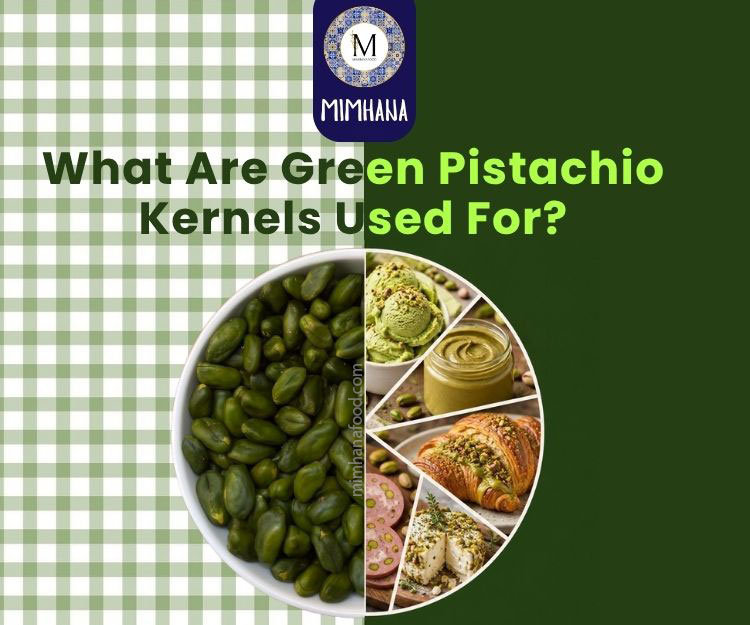
What are green pistachio kernels used for? Green pistachio kernels are used in professional food production for a wide range of applications. They are more than a source of pistachio flavor: the same raw material can be processed into different forms and used for very different purposes, from pistachio paste for gelato and creams to chopped or granulated kernels for visible inclusions, toppings, and confectionery applications.
The choice of kernel therefore depends not only on its color or flavor, but also on what the manufacturer needs the ingredient to do during processing. A gelato producer looking for a smooth pistachio base may prioritize a kernel with strong flavor and good suitability for grinding, while a pastry or chocolate manufacturer may need a different particle size or physical form to achieve the desired texture and appearance.
This distinction becomes particularly important with green pistachio kernels, where color intensity, flavor profile, kernel condition, and the intended degree of processing can all influence the final ingredient. In professional applications, green pistachio kernels may be ground into pistachio paste, milled into a finer powder, or processed into larger pieces depending on the formulation and the desired characteristics of the final product. Each form serves a different purpose and can affect how pistachio is incorporated into a food product.
In this guide, we examine how green pistachio kernels are used in gelato, ice cream, pastry, bakery, chocolate, and pistachio paste production, and what buyers should consider when selecting a kernel for each application. For a detailed overview of kernel grades, color characteristics, and quality considerations, see our guide to Green Pistachio Kernel grades.
Green Pistachio Kernels for Gelato
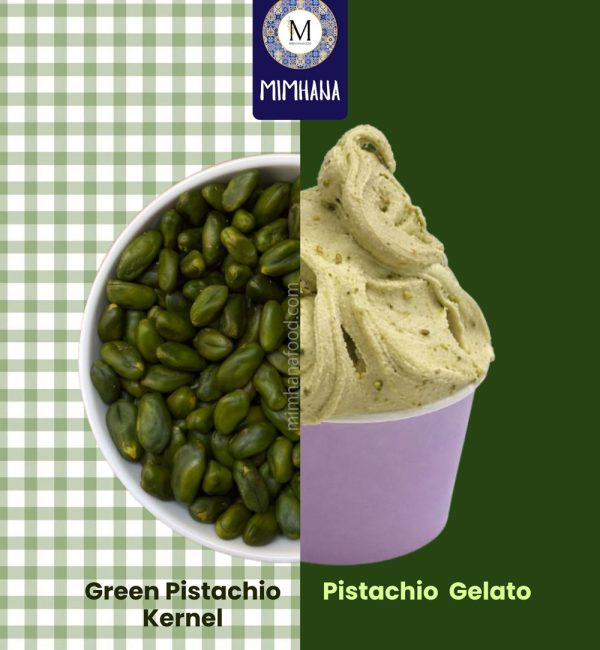
In professional gelato production, green pistachio kernels are often processed into pistachio paste before being incorporated into the gelato mix. The kernel is therefore not necessarily used as a whole nut in the final product. Instead, its color, flavor, quality, and suitability for grinding can influence the characteristics of the pistachio ingredient used in the formulation.
From Green Pistachio Kernels to Pistachio Paste
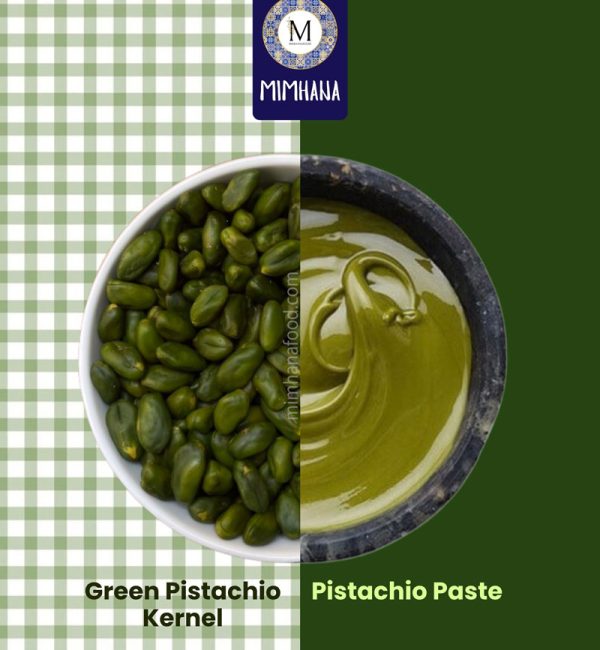
The first step is to reduce the kernels to a fine and homogeneous paste through grinding or refining. As the pistachios are processed more extensively, their natural fats are released, changing the physical structure from finely ground particles into a creamy, concentrated paste. The resulting pistachio paste can then be incorporated into gelato, pastry creams, chocolate fillings, and other formulations.
The distinction between pistachio kernels, flour, granules, and paste is important because these forms serve different purposes. Pistachio paste, flour, and granules have different particle sizes, textures, and functional uses, with pistachio paste being particularly suitable when a concentrated pistachio flavor needs to be incorporated into a smooth preparation.
Pistachio paste is produced by grinding pistachio kernels to achieve the particle size and consistency required for the intended application. Depending on the processing method and formulation, the resulting paste can be incorporated into products such as gelato, ice cream, chocolate, confectionery, and pastry.
How Pistachio Paste Is Used in Gelato Production
Once the pistachio kernels have been converted into paste, the paste can be incorporated directly into the gelato mix. In applications such as gelato, pistachio paste is typically incorporated into the mix and dispersed thoroughly to achieve an even distribution of the pistachio ingredient. The specific processing sequence and mixing conditions depend on the formulation and the equipment used by the manufacturer.
The exact amount of pistachio paste depends on the formulation and the characteristics of the finished gelato.
The important point for kernel buyers is that the pistachio kernel acts as the raw material from which the pistachio ingredient is produced; the final gelato formulation may contain additional ingredients that determine its sweetness, fat content, texture, and overall balance.
What Should Buyers Look for in Kernels Intended for Gelato?
When green pistachio kernels are intended for grinding into pistachio paste, the selection criteria can differ from those used for kernels that will remain visible in the finished product.
Key considerations include:
• Pistachio flavor: The kernel should provide a clear and characteristic pistachio flavor after processing.
• Green color: Stronger green coloration can contribute to a more pronounced green appearance in the resulting paste, depending on the formulation and processing conditions.
• Suitability for grinding: The kernels should be suitable for the intended grinding process and capable of producing the desired paste characteristics.
• Consistency between lots: Consistent color, flavor, and quality help manufacturers achieve more repeatable results from batch to batch.
• Food safety and quality: The kernels should meet the buyer’s specifications for relevant quality and safety parameters.
For gelato manufacturers, the choice of pistachio kernels should be based on the characteristics required in the final pistachio paste and gelato. Key factors include green color intensity, pistachio flavor, overall quality, and suitability for grinding. Buyers should select the grade that best matches their formulation and the desired color and flavor profile of the finished product.
Green Pistachio Kernels for Ice Cream
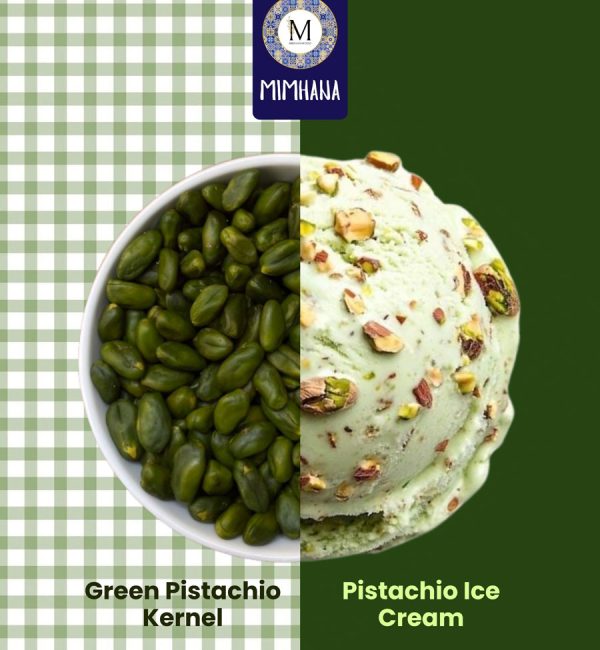
In ice cream production, green pistachio kernels are typically processed into a pistachio ingredient before being incorporated into the ice cream mix. Depending on the formulation, the kernels may be ground into a fine paste or processed into another suitable form to provide pistachio flavor, color, and fat to the product.
How Pistachio Ingredients Are Incorporated into Ice Cream
After processing, the pistachio ingredient is blended into the ice cream mix together with the other components of the formulation. The way it is incorporated can affect how evenly the pistachio flavor, color, and fat are distributed throughout the mix.
Pistachio Flavor, Fat and Texture in Ice Cream
Pistachio kernels naturally contain a substantial amount of oil, which becomes relevant when the kernels are ground and incorporated into an ice cream formulation. The resulting pistachio ingredient can contribute not only flavor and color, but also part of the fat phase of the product.
The final texture, however, is determined by the complete formulation rather than by pistachio kernels alone. Milk solids, sugars, fats, stabilizers, emulsifiers, and processing conditions all interact to determine characteristics such as creaminess, body, melting behavior, and overall mouthfeel.
Green Pistachio Kernels for Pastry
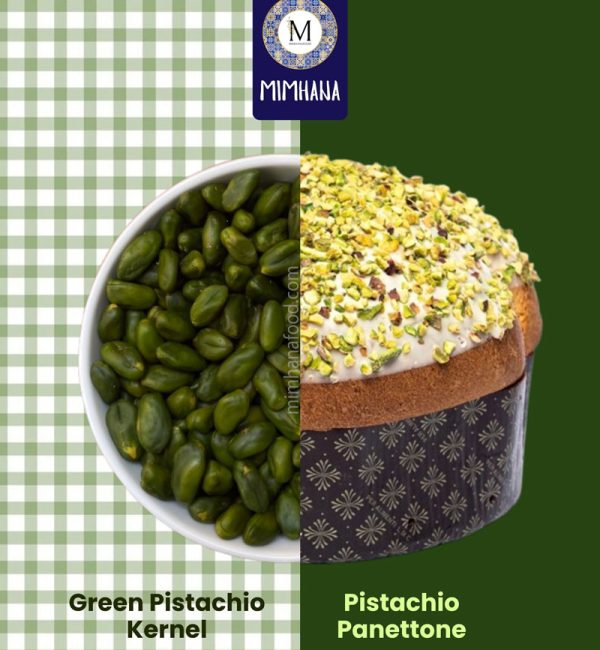
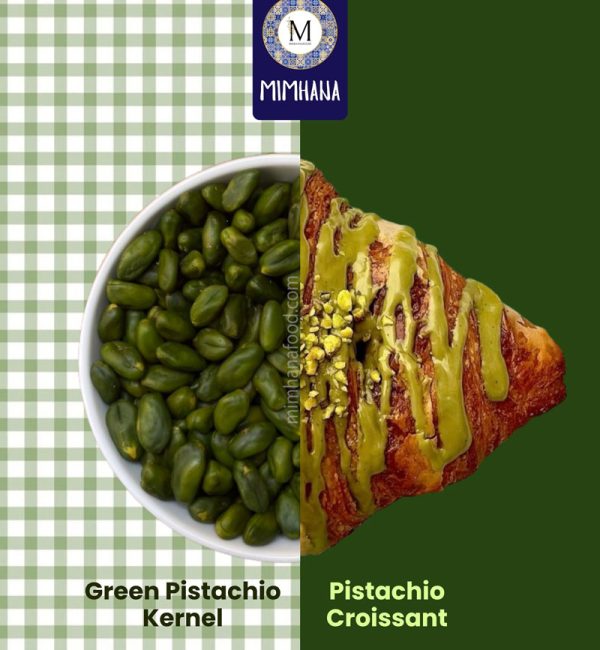
Green pistachio kernels are widely used in pastry production in different forms, depending on the structure and appearance required in the final product. They can be processed into pistachio paste for creams and fillings, or used as ground, chopped, or whole kernels when the pistachio pieces themselves are part of the finished product.
Pistachio Paste and Creams in Pastry
In pastry production, green pistachio kernels can be ground into a smooth paste and incorporated into creams, fillings, mousses, and other preparations. Processing the kernels into a paste allows the pistachio ingredient to be distributed throughout the formulation while providing concentrated pistachio flavor and color. The physical characteristics of pistachio paste can also be influenced by processing conditions, including particle size. Scientific research on pistachio paste and spread formulations has shown that particle size can affect rheological and textural properties, which can be relevant when developing pistachio-based preparations with specific consistency and processing requirements. Research on the rheological and textural properties of pistachio paste provides further insight into these relationships. [1]
Whole, Chopped and Ground Kernels in Pastry
Not every pastry application requires pistachios to be converted into a paste. Whole or chopped kernels can be used when visible pistachio pieces, texture, or decoration are required.
Ground kernels can also be incorporated into pastry mixtures where a finer particle size is preferred. The appropriate form therefore depends on whether the pistachio is intended to provide flavor throughout the preparation, visible pieces and texture, or both.
For applications where the appearance of the pistachio is important, whole and uniformly colored kernels may be preferred. For creams, fillings, and preparations that require further processing, ground or processed forms may be more practical.
Green Pistachio Kernels for Bakery
Green pistachio kernels can be used in a wide range of bakery applications, including doughs, fillings, creams, and inclusions. The appropriate raw material should be selected according to the requirements of the final product, taking into account factors such as pistachio flavor, color, quality, processing requirements, and the role of pistachio in the formulation.
Pistachio Kernels in Doughs, Fillings and Inclusions
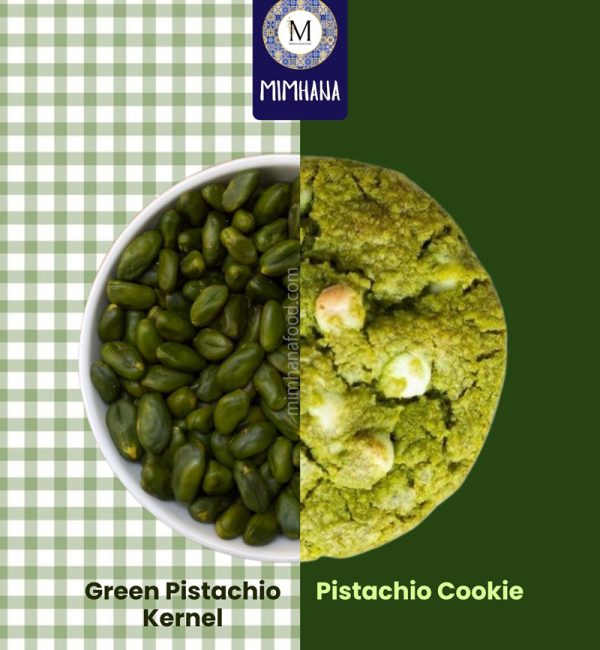
When pistachio is incorporated directly into a dough, the form and amount of pistachio ingredient can influence the characteristics of the finished baked product. Ground pistachio, for example, can be incorporated into flour-based doughs to distribute pistachio components throughout the structure.
Scientific research on pistachio-fortified bread has shown that adding pistachio powder to wheat flour or semolina can affect the physical characteristics of the resulting bread. In one study, pistachio powder influenced bread height, firmness, crumb structure, and color, while the fermentation behavior of the baker’s yeast remained similar to the control doughs. Research on pistachio powder in bread production provides further evidence of these effects. [2]
Pistachio can also be used as an inclusion or filling ingredient rather than being incorporated throughout the dough. In these applications, chopped or whole kernels can provide visible pistachio pieces and texture, while ground kernels or pistachio paste can be used when a more uniform distribution of pistachio flavor is required.
Green Pistachio Kernels for Baklava
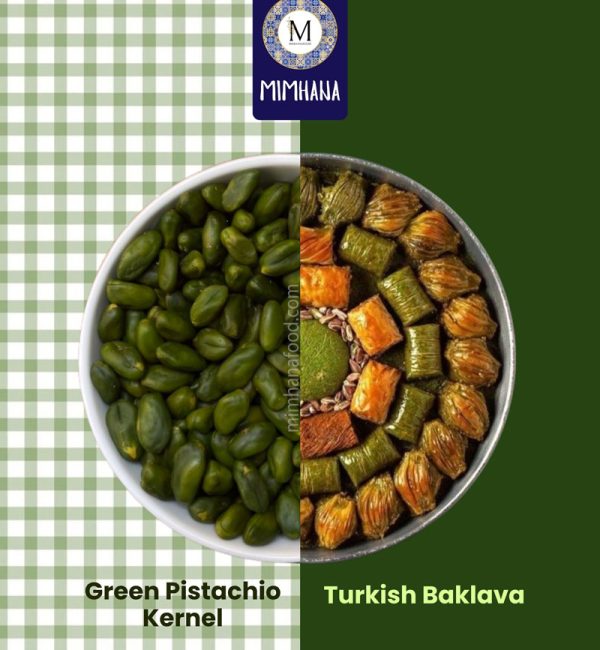
Green pistachio kernels are widely used in baklava, a traditional pastry found in Turkish, Iranian, and other Middle Eastern cuisines. Finely ground or chopped pistachios are commonly layered between sheets of pastry or used as a filling, contributing a distinctive pistachio flavor, texture, and green color to the finished product.
The color and quality of the kernels can influence the visual appeal of baklava, particularly when pistachios are used as a visible filling or garnish. Depending on the recipe and presentation, manufacturers and pastry chefs may choose different kernel forms and grades to achieve the desired appearance and flavor.
When selecting green pistachio kernels for baklava production, buyers should consider color intensity, flavor, freshness, and particle size to match the product’s recipe and quality requirements.
Green Pistachio Kernels for Pizza
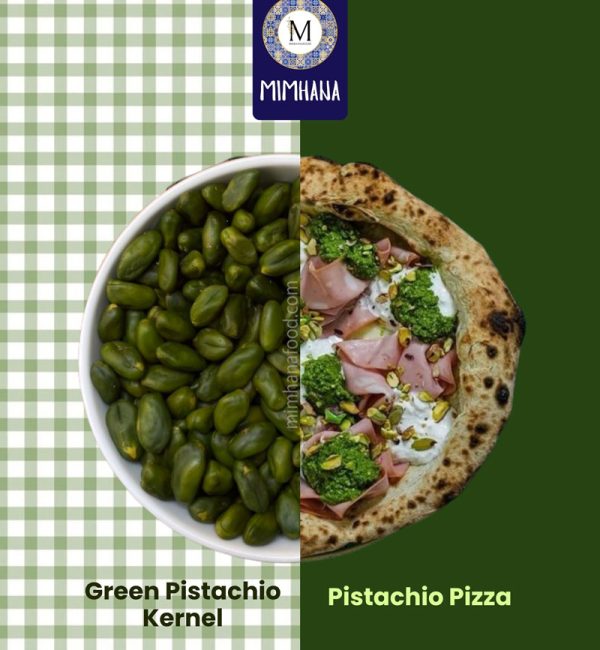
Green pistachio kernels can be used as a topping in specialty pizza recipes, adding pistachio flavor, texture, and visual appeal. They are particularly suitable for recipes that combine pistachios with cheese and other complementary ingredients.
In Italian-style pizza, pistachios are often paired with ingredients such as mozzarella, ricotta, and mortadella. Chopped green pistachio kernels can be sprinkled over the pizza to provide visible pieces, a distinctive green color, and a characteristic pistachio flavor.
Green Pistachio Kernels for Cheese
Green pistachio kernels can be incorporated into specialty dairy cheeses to add a distinctive flavor, texture, and visual appeal. Chopped pistachio kernels can be mixed into the cheese or distributed throughout the product, creating visible green pieces that complement the cheese’s appearance and flavor profile.
Green Pistachio Kernels for Mortadella
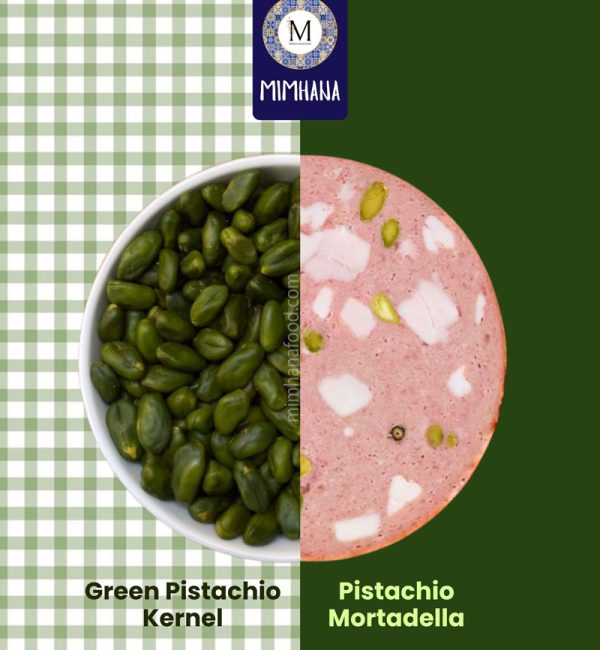
Green pistachio kernels are a characteristic ingredient in mortadella, an Italian cooked sausage in which pistachio pieces are distributed throughout the meat mixture. They contribute a distinctive pistachio flavor, visible green pieces, and contrast in texture, making them an important part of the product’s appearance and identity.
For mortadella production, pistachio kernels are typically incorporated into the meat mixture before cooking. The kernels should retain a recognizable appearance and complement the texture of the finished sausage.
Green Pistachio Kernels for Pasta
Green pistachio kernels can be used in pasta dishes to add pistachio flavor, a distinctive green color, and texture. Finely chopped or coarsely ground kernels can be incorporated into pasta recipes or sprinkled over the finished dish as a garnish. They pair well with ingredients such as Parmesan, ricotta, and olive oil.
In fresh pasta production, pistachio kernels can also be incorporated into fillings for stuffed pasta, depending on the recipe. Their color, flavor, and particle size influence the appearance and eating experience of the finished product.
Green Pistachio Kernels for Chocolate & Confectionery
Green pistachio kernels are an important raw material in chocolate and confectionery manufacturing, valued for their characteristic flavor, natural green color, and versatility in different product formulations. They can be used whole, chopped, or ground, depending on the product design and the role pistachio is intended to play in the finished chocolate.
Pistachio Kernels in Chocolate Fillings
One of the main applications of green pistachio kernels is the production of pistachio-based fillings. The kernels can be ground into pistachio paste and incorporated into chocolate fillings, pralines, bonbons, and filled chocolate bars. Depending on the formulation, the filling may combine pistachio paste with ingredients such as sugar, milk components, or fats to achieve the desired sweetness, consistency, and melting behavior.
The quality of the kernels used as the starting material influences the flavor and color of the resulting pistachio ingredient. For manufacturers developing fillings with a pronounced pistachio character, kernel selection should consider not only flavor but also color intensity and batch consistency.
Whole and Chopped Kernels in Chocolate Products
Green pistachio kernels can also be used as visible inclusions in chocolate. Whole or chopped pieces may be incorporated into chocolate bars, pralines, and other confectionery products, providing a contrast between the chocolate and pistachio pieces.
In these applications, appearance and particle size are important. Larger pieces create a more visible pistachio presence, while smaller pieces allow more even distribution throughout the product. The appropriate form depends on the recipe, the intended texture, and the appearance required by the manufacturer.
Dubai Chocolate: Pistachio Filling and Crunchy Texture
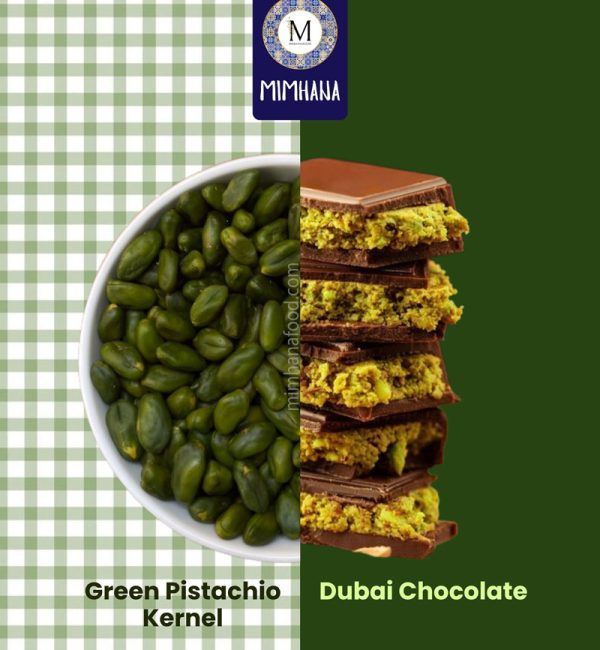
Dubai chocolate has brought particular attention to the use of pistachio ingredients in filled chocolate bars. Its characteristic style combines a chocolate shell with a pistachio-based cream and crispy kadayif, the fine strands of pastry used in Middle Eastern desserts. Some formulations also include tahini or other ingredients, depending on the recipe.
For this type of product, green pistachio kernels serve as a raw material for producing the pistachio paste or cream used in the filling. Their color and flavor contribute to the filling’s characteristic profile, while the crispy kadayif provides a contrasting texture against the smooth cream and firm chocolate shell.
The quality of the pistachio ingredient matters because the filling is a defining component of the product. Manufacturers should assess the color, flavor, and consistency of the pistachio material rather than relying on color alone. The final result also depends on the complete formulation and the balance between the filling, the crunchy inclusions, and the chocolate coating.
Why Kernel Quality Matters in Chocolate Manufacturing
Pistachio-based chocolate formulations require attention to both sensory qualities and physical properties. Research published in Food Science & Nutrition in 2023 examined pistachio-based chocolate formulations and evaluated characteristics including hardness, graininess, spreadability, fluidity, and mouthfeel. The study illustrates how formulation choices can affect the texture and sensory properties of pistachio-based chocolate products.
For manufacturers, selecting green pistachio kernels should begin with the requirements of the intended application. When the kernels will be ground for a filling, the desired color intensity, pistachio flavor, and consistency of the raw material are important considerations. When visible pieces are required, kernel appearance, particle size, and uniformity become more prominent.
The most suitable grade is the one that meets the product’s specific quality requirements. A consistent supply of kernels with the appropriate color and flavor profile helps manufacturers develop chocolate products that meet their intended sensory and visual standards.
Green Pistachio Kernels for Pistachio Paste
Green pistachio kernels can be processed into pistachio paste through grinding and particle-size reduction. The resulting paste is used as an ingredient in products such as gelato, ice cream, pastry, chocolate, and confectionery.
Both the raw material and the milling process influence the characteristics of the final paste. Particle size, milling conditions, kernel color, and raw-material quality can affect its texture, flow behavior, color, and stability.
How Green Pistachio Kernels Become Pistachio Paste
Pistachio paste is produced by grinding kernels until the desired particle size and degree of homogeneity are achieved. Milling is therefore a key processing stage that determines part of the paste’s final structure and behavior.
Research on pistachio paste has shown that milling conditions can influence particle size, colloidal stability, color, and rheological properties. The required degree of grinding should therefore be determined by the specifications of the intended application.
What Makes a Kernel Suitable for Grinding?
For paste production, grinding performance should not be considered separately from raw-material quality. Buyers should evaluate factors such as:
• Green color intensity
• Pistachio flavor
• Kernel quality and condition
• Lot-to-lot consistency
• Suitability for the intended milling process
• Food safety and specification requirements
Whole, high-grade kernels can be suitable for grinding when strong color, flavor, and consistent raw-material quality are required. Being destined for grinding does not automatically make fragmented or lower-grade material the better choice.
Color and Flavor in Pistachio Paste Production
Because pistachio paste is produced directly from the kernels, the characteristics of the raw material contribute to the color and sensory profile of the finished paste.
Milling also affects the physical behavior of the ingredient. Research on milling and the rheological properties of pistachio paste has shown that milling conditions and particle-size reduction can affect colloidal stability, color, and flow behavior. [3]
For manufacturers producing pistachio paste for different food applications, the selection of kernels should therefore reflect both the quality of the raw material and the technical requirements of the final paste.
How Kernel Color and Flavor Affect the Final Product
The color and flavor of green pistachio kernels can influence the sensory and visual characteristics of pistachio-based foods. Their importance, however, depends on the formulation and the role of pistachio in the finished product.
The Role of Green Color in Pistachio-Based Products
Green color is often an important characteristic in products where pistachio is visually prominent, such as gelato, ice cream, pastry creams, fillings, and confectionery products.
The intensity and uniformity of the kernel color can therefore affect the appearance of ingredients made from the kernels, including pistachio paste. When a strong and distinctive green appearance is required, manufacturers may select kernels with a more intense and uniform green color.
The desired color should ultimately be determined by the specifications of the finished product rather than by kernel color alone.
Pistachio Flavor After Processing
Pistachio flavor is another important consideration when selecting kernels for food production. Since the kernels may be ground, blended, baked, or incorporated into other formulations, their flavor needs to remain appropriate for the intended application.
The final sensory profile is also affected by processing conditions and by other ingredients in the formulation. For this reason, kernel selection should consider both the inherent pistachio flavor of the raw material and how that flavor is expected to contribute to the finished product.
For manufacturers, evaluating color and flavor together with processing performance and lot-to-lot consistency provides a more reliable basis for selecting green pistachio kernels.
Whole vs. Broken Green Pistachio Kernels: Which Should You Choose?
When selecting green pistachio kernels for food production, manufacturers primarily consider the color, quality, and characteristics required in the finished product. Whether the kernels are whole or broken is only one factor in the purchasing decision. The most suitable grade depends on the manufacturer’s specifications, processing requirements, and desired product characteristics.
To compare the available grades and their color profiles, see our green peeled pistachio kernels product page.
When Whole Kernels Are Preferred
Whole green pistachio kernels in higher grades may be preferred when manufacturers require intense green coloration, consistent color, and high raw-material quality. These characteristics can be particularly important when producing pistachio paste or other ingredients in which the color and quality of the original kernels influence the finished product.
Even when the kernels will eventually be ground, whole, high-grade kernels may be selected to achieve the desired color intensity and quality. Therefore, the fact that a product will be processed into a paste does not automatically make broken kernels the preferred option.
When Broken Kernels Can Be a Suitable Choice
Broken green pistachio kernels can be a suitable option when their color and quality meet the manufacturer’s requirements. For example, Grade F consists of broken kernels from Grades S, A, and B. As these source grades vary in color, Grade F can contain both dark-green and lighter-green pieces.
Consequently, broken kernels should not be treated as a single, uniform category in terms of color. Manufacturers should evaluate the actual color profile and quality of the grade offered against their product specifications.
Ultimately, the choice between whole and broken green pistachio kernels—and between different grades—should be based on the required color intensity, raw-material quality, consistency, and intended application. The lowest-priced option is not necessarily the most suitable; the priority is to select a grade that meets the manufacturer’s requirements.
For a more detailed overview of purchasing considerations, see our guide on how to buy green pistachio kernels.
Confirm Specifications and Food Safety Requirements
Before placing an order, buyers should confirm the product specifications relevant to their application. These may include color requirements, moisture content, microbiological criteria, aflatoxin limits, packaging, and other quality parameters, depending on the intended use and destination market.
Manufacturers should also clarify the applicable food safety requirements and request the relevant technical documentation, such as a product specification sheet and certificate of analysis (COA), where available.
A clear agreement on product specifications, sample approval, and documentation helps reduce uncertainty and ensures that the selected grade is appropriate for the intended production process.
Conclusion
Selecting green pistachio kernels for food production requires more than choosing a grade based on appearance alone. Color intensity, pistachio flavor, raw-material quality, consistency, and processing requirements all contribute to determining the most suitable option for each application.
From gelato and ice cream to pastry, bakery, chocolate, and pistachio paste production, the right choice depends on the specifications of the finished product and the manufacturer’s priorities.
Mimhanafood offers seven grades of Iranian green peeled pistachio kernels, providing buyers with different options to match their color and quality requirements. Explore our green peeled pistachio kernels or contact us to request product specifications and discuss your application requirements.
References
Recent Blogs
Green pistachio kernel is a specialized pistachio ingredient valued for its intense green color, distinctive flavor, and versatility in food production. Unlike conventional pistachio...


